Reviewing the Funny Llama SVG for Embroidery Projects
As a designer who has spent countless hours digitizing and testing files for real-world production, I approach every new asset with a mix of curiosity and caution. When I first opened Llama Svg, Funny Llama Svg, my immediate reaction was not just about the cuteness factor, but about its structural integrity for stitching. We often see whimsical illustrations that look charming on a screen but turn into a tangled mess under the needle. This particular file, categorized under Illustrations and Graphics, promises full editability as an EPS10 vector. But does it hold up when translated from digital lines to physical thread?
First Impressions: Mood and Visual Personality
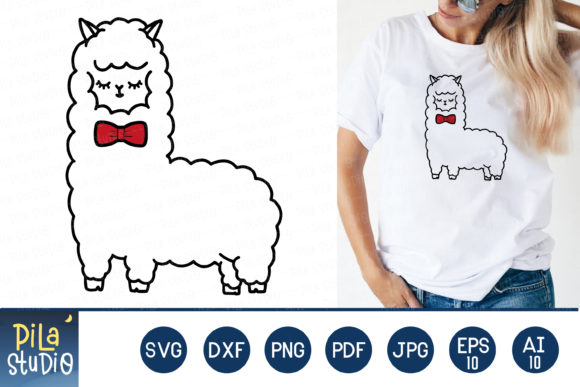
The design exudes a playful, lighthearted mood that is currently trending in the handmade market. The lines are clean, and the character’s expression carries a distinct personality that resonates well with modern consumers. For embroidery designers, the simplicity of the shape is a double-edged sword. It allows for quick stitching times, which is crucial for profitability in a craft business, but it also demands precision. There is nowhere to hide poor digitizing in simple designs. The visual personality suggests this is perfect for casual, fun items rather than formal or high-end luxury goods. It feels native to boutique branding and small shop products that aim to connect with customers through humor and warmth.
Real-World Application: The Tote Bag Test
To evaluate Llama Svg, Funny Llama Svg, practically, I envisioned a specific project: a custom embroidered tote bag for a local farmer’s market vendor. Canvas is a forgiving fabric, but it has a distinct texture that can swallow fine details. I imagined placing this llama design on the front panel, centered for maximum visibility. The vector nature of the file means I could scale it precisely to fit a 5x7 hoop without losing clarity. In this scenario, the design acts as a focal point. The funny aspect of the llama invites conversation, making the tote bag not just a utility item but a piece of wearable art. For Etsy sellers, this kind of engagement is vital. It transforms a standard product into a memorable gift.
Performance on Different Fabrics
When moving beyond canvas, the performance of this design varies. On a sweatshirt, the fluffy texture of fleece or French terry requires careful consideration of stitch density. If the original vector paths are too close together, the stitches might pile up, creating a stiff patch that pulls the fabric. However, since the file is a vector graphic saved as EPS10, I have the control to adjust spacing before digitizing. This is where the "fully editable" claim becomes valuable. I can widen gaps slightly to accommodate the nap of the fabric. For baby embroidery, such as a onesie or bib, the softness of the garment is paramount. Here, I would likely convert parts of the design into an applique design to reduce bulk, using the vector outline as the cutting guide. This keeps the finished product soft against sensitive skin while maintaining the visual appeal of the llama.
Technical Considerations for Stitching Clarity
One of the most critical aspects of using a vector file for embroidery is understanding that vectors are not stitch files. They are outlines. As an experienced reviewer, I must emphasize that you cannot simply import an EPS10 into your embroidery machine. You need to digitize it or use auto-digitizing software with caution. The Llama Svg, Funny Llama Svg, provides excellent source material because the lines are smooth. When converting to a machine embroidery design, pay close attention to corner sharpness. Vector corners can be mathematically perfect, but thread has thickness. Sharp internal corners often require tie-offs or specific stitch angles to prevent looping.
For those using satin stitch for the outlines, ensure the width is appropriate for the hoop size. A narrow satin stitch on a large hoop might look spindly, while a wide satin stitch on a small detail might cause registration issues. Fill stitch should be used sparingly in this design to maintain its lightweight feel. Over-filling can make the llama look heavy and distort the fabric, especially on stretchy materials like t-shirts. Always test the design on scrap fabric first. This step is non-negotiable. Check thread color contrast against both light and dark backgrounds. A black llama on navy blue might disappear, whereas a bright turquoise llama on white cotton pops with energy.
Navigating Challenging Surfaces
Curved surfaces like caps present unique challenges. The Llama Svg, Funny Llama Svg, works well here if scaled correctly. The front panel of a cap is limited in space, so the design must be simplified. I would recommend removing any tiny internal details that might get lost in the curve. Use a strong stabilizer to prevent puckering, which is common on structured hats. Similarly, for embroidered patches, the design’s bold lines translate well to merrowed edges. The vector scalability ensures that whether you are making a 2-inch patch or a 4-inch one, the proportions remain consistent. This consistency is key for brand recognition if you are selling these as part of a collection.
Commercial Viability and Brand Consistency
For commercial embroidery projects, the value of this design lies in its versatility. It fits seamlessly into holiday embroidery collections, particularly for Easter or spring-themed items, given the llama’s association with gentle, pastoral vibes. It also works for personalized gifts, where a name can be added below the llama. The clean lines of the vector make it easy to integrate text without cluttering the composition. For digital product sellers, this file serves as a robust asset for creating printable mockups. You can showcase how the design looks on various products without actually stitching every sample, saving time and resources.
However, buyer engagement depends on presentation. A poorly stitched llama will deter customers. Ensure that your thread colors are vibrant and that the tension is balanced. The professionalism of your finished product reflects directly on your brand. If the stitches are loose or the fabric is puckered, the "funny" aspect turns into "amateur." Trust is built on quality. When customers see a crisp, well-executed Llama Svg, Funny Llama Svg, they perceive higher value. This perception allows for better pricing power in your small shop product lineup.
Final Designer Notes and Best Practices
Before launching any product featuring this design, confirm the licensing terms. While the file is described as fully editable and compatible with Illustrator 10 or higher, always verify if the license covers commercial use for physical goods and digital resale. Do not assume. Check the specific documentation provided with the download. Additionally, inspect the vector nodes. Sometimes, auto-traced vectors have unnecessary anchor points that can complicate digitizing. Clean up the path in your vector software before importing it into your digitizing program.
- Test on multiple fabric types to determine optimal stabilizer usage.
- Adjust stitch density based on fabric weight and texture.
- Use contrasting thread colors to enhance visual appeal.
- Verify hoop size compatibility for your specific machine model.
- Consider applique techniques for bulky garments like hoodies.
In conclusion, Llama Svg, Funny Llama Svg, is a strong contender for your design library. It offers the flexibility needed for diverse applications, from baby clothes to tote bags. Its success, however, depends entirely on the skill of the digitizer and the care taken during production. Treat it as a foundation, not a final product. With proper attention to detail, it can become a bestseller in your Etsy store or a favorite among your custom apparel clients. The key is to respect the material constraints of embroidery while leveraging the creative freedom the vector format provides.